THE RESEARCH SAFARI
  • Home
    • Knowledge Compass
    • Studyvibe
  • A-Z
  • Inquiry Process
    • The Research Grid
    • Key Stages of an Inquiry
    • Research Funnel
  • DEFINING
    • Mindmapping
    • Starburst Brainstorming
    • Graphic Organisers >
      • Student Showcase
    • Questions and Questioning >
      • Knowledge Compass
    • Research Task Verbs
  • LOCATING
    • Great Research Reference Sites
    • Searching the Web >
      • Boolean Searching
    • Searching with Google
    • Sources of Information
    • Website Evaluation
    • Fake websites
  • SELECTING
    • Content Curation
    • Creative Commons
    • Image Library
    • Notemaking >
      • Notemaking Apps and tools
      • Notemaking videos
    • Plagiarism
    • Referencing
  • ORGANISING
  • PRESENTING
    • Animation Tools >
      • Avatars
    • Brochure
    • Cartoon Makers
    • Digital Storytelling >
      • Digital Storytelling Resources
    • eBooks
    • Essay Writing
    • Infographics
    • Multimedia Presentations
    • Oral Presentations
    • Podcast
    • Posters >
      • Pic Collage Gallery
    • Website
  • EVALUATING
  • Mini Safaris
  • Trail Blazers
    • Trailblazer Subscription
    • The Ancient World >
      • Ancient China (Teachers)
      • Ancient China (Students)
      • Ancient Egypt
    • Bees >
      • Bees - Curriculum Links
    • Biomes >
      • Biomes - Curriculum Links
    • Cane Toads
    • Colonial Australia
    • Coral Reefs
    • Deserts
    • Dugongs
    • Government >
      • Government Curriculum Links
    • Great Pacific Garbage Patch
    • Introduced Species >
      • Introduced Species - Curriculum Links
    • Medieval Europe >
      • The Black Death
      • Christianity
      • Medieval Warfare
      • Curriculum Links
    • Rainforests
    • Renewable Energy >
      • Bioenergy
      • Geothermal Energy
      • Hydroelectric Power
      • Solar Energy
      • Wind Energy
    • Shogun Japan >
      • Gallery
    • Water >
      • Water images and infographics
      • Water Videos
      • Curriculum Links
    • Whales
  • Teacher Zone
    • All things Google
    • Australian Curriculum Links
    • Information Literacy Models
    • Information Literacy as a Transversal Competency
    • Infographic Library
    • Learning Frameworks
    • Project Websites
    • Real World Learning
    • Topic Ideas
    • Worksheet Library
  • Links
    • Knowledge Compass
    • Studyvibe
    • UN Sustainable Development Goals Project
    • Inspired Libraries Website
    • Teenage identity and Social Media

Boolean Searching

What is Boolean Search?
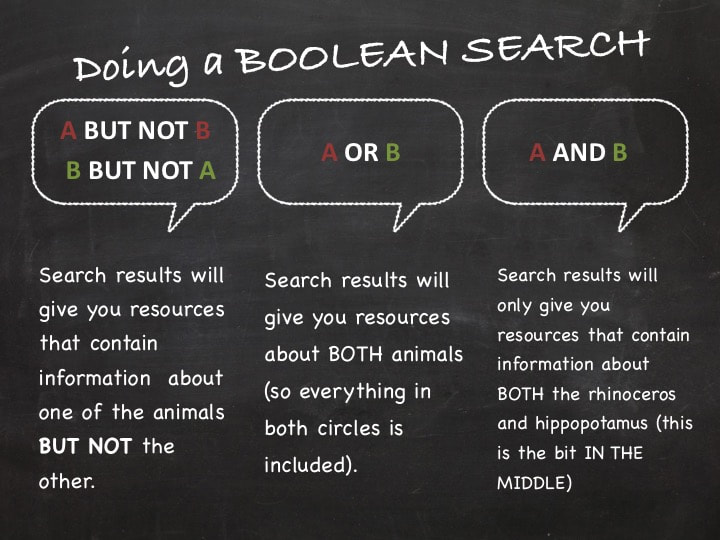
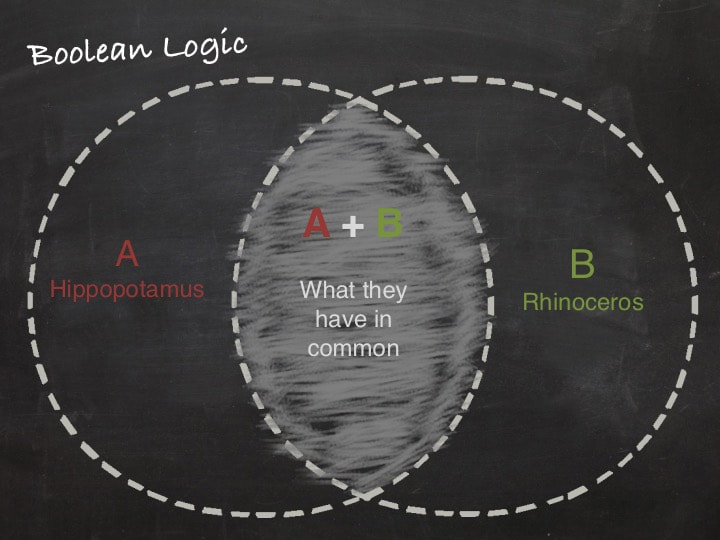
Boolean searches allow you to combine words and phrases using the words AND, OR, NOT and NEAR (otherwise known as Boolean operators) to limit, widen, or define your search. Most Internet search engines and Web directories default to these Boolean search parameters anyway, but a good Web searcher should know how to use basic Boolean operators.

Where does the term Boolean originate?  George Boole, an English mathematician in the 19th century, developed "Boolean Logic" in order to combine certain concepts and exclude certain concepts when searching databases.

How do I do a Boolean Search?
The most common strategy is to use the standard Boolean operators AND, OR, NOT, or NEAR.
  • The Boolean search operator AND is equal to the "+" symbol.
  • The Boolean search operator NOT is equal to the "-" symbol.
  • The Boolean search operator OR is the default setting of any search engine; meaning, all search engines will return all the words you type in, automatically.
  • The Boolean search operator NEAR is equal to putting a search query in quotes, i.e., "sponge bob squarepants". You're essentially telling the search engine that you want all of these words, in this specific order, or this specific phrase.
Adapted from http://websearch.about.com/od/2/g/boolean.htm
Picture
Picture
  • Home
    • Knowledge Compass
    • Studyvibe
  • A-Z
  • Inquiry Process
    • The Research Grid
    • Key Stages of an Inquiry
    • Research Funnel
  • DEFINING
    • Mindmapping
    • Starburst Brainstorming
    • Graphic Organisers >
      • Student Showcase
    • Questions and Questioning >
      • Knowledge Compass
    • Research Task Verbs
  • LOCATING
    • Great Research Reference Sites
    • Searching the Web >
      • Boolean Searching
    • Searching with Google
    • Sources of Information
    • Website Evaluation
    • Fake websites
  • SELECTING
    • Content Curation
    • Creative Commons
    • Image Library
    • Notemaking >
      • Notemaking Apps and tools
      • Notemaking videos
    • Plagiarism
    • Referencing
  • ORGANISING
  • PRESENTING
    • Animation Tools >
      • Avatars
    • Brochure
    • Cartoon Makers
    • Digital Storytelling >
      • Digital Storytelling Resources
    • eBooks
    • Essay Writing
    • Infographics
    • Multimedia Presentations
    • Oral Presentations
    • Podcast
    • Posters >
      • Pic Collage Gallery
    • Website
  • EVALUATING
  • Mini Safaris
  • Trail Blazers
    • Trailblazer Subscription
    • The Ancient World >
      • Ancient China (Teachers)
      • Ancient China (Students)
      • Ancient Egypt
    • Bees >
      • Bees - Curriculum Links
    • Biomes >
      • Biomes - Curriculum Links
    • Cane Toads
    • Colonial Australia
    • Coral Reefs
    • Deserts
    • Dugongs
    • Government >
      • Government Curriculum Links
    • Great Pacific Garbage Patch
    • Introduced Species >
      • Introduced Species - Curriculum Links
    • Medieval Europe >
      • The Black Death
      • Christianity
      • Medieval Warfare
      • Curriculum Links
    • Rainforests
    • Renewable Energy >
      • Bioenergy
      • Geothermal Energy
      • Hydroelectric Power
      • Solar Energy
      • Wind Energy
    • Shogun Japan >
      • Gallery
    • Water >
      • Water images and infographics
      • Water Videos
      • Curriculum Links
    • Whales
  • Teacher Zone
    • All things Google
    • Australian Curriculum Links
    • Information Literacy Models
    • Information Literacy as a Transversal Competency
    • Infographic Library
    • Learning Frameworks
    • Project Websites
    • Real World Learning
    • Topic Ideas
    • Worksheet Library
  • Links
    • Knowledge Compass
    • Studyvibe
    • UN Sustainable Development Goals Project
    • Inspired Libraries Website
    • Teenage identity and Social Media